TUBUAI ARTIFACTS
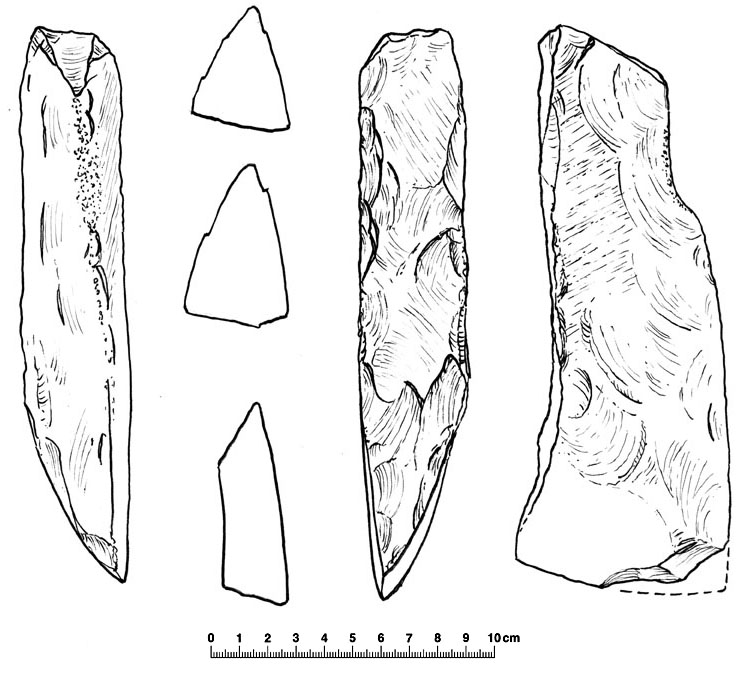
Diagram 22.1
Adze Type 5A
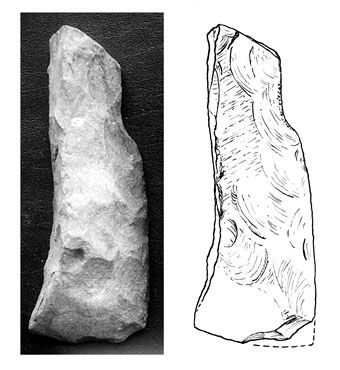
This very rare specimen was purchased locally, the artifact is said to have been found in the family garden (possibly from ATIAHARA #3) it has been recently stained by oils, perhaps spending sometime on a shelf in the garage or kitchen, and is now a mottled grey black colour. Normally colour can be of considerable aid in assessing the age of a stone artifact, here however I am at a loss with only some isolated calcareous encrustation's perhaps suggesting a considerable antiquity.
This is the first complete, finished specimen of this type thus far discovered in the Tubuai collection of well over a thousand adzes. Probably one or two broken fragments are of thus type but certainly the count of Duff Type 5A side-hafted adze in Tubuai is less than .5%.
The left side of this adze appears almost wholly unmodified being the a naturally flat surface of the original blank, sparingly chipped along the median ridge. This naturally flat side has then been minimally ground near the blade tip. Similarly the bevel which forms on the right side has been ground minimally, no effort has been made to create well formed bevel margins. The bevel merges irregularly with the scars of the right side which then remains unground, the back is also without grinding.
Pecking is very limited, virtually confined to the butt part of the median ridge creating a shallow shoulder. The poll slopes forward without the formation of a distinct horn, see the Marquesan Koma Type illustrated by Suggs (1961, Fig. 31b) for a similar formation of the butt (pecking however may be absent).
The most remarkable resemblance to this specimen is that shown by the New Zealand examples Duff (1956, Page 191, Figure 48) describes an illustrated Hurunui example: "Fig 48 also includes one of the two Hurunui adzes of this type, the largest and best finished example of Type 5 known to me. In the side view, the back is strongly concave. the grip boldly marked as in the 4A, and with something approaching the projecting poll knob of the latter, at the base the cutting edge sweeps downwards in a manner reminiscent of a European axe, the strongly ground bevel on the 'right' or 'inner' side of the blade extending back over more than one third of the adze."
Skinner illustrates (1938, page 172, Figure 21) another very similarly shaped New Zealand example from Te Rawa, Marlborough. The poll of Skinners example demonstrates a forward slope without a distinct horn as well as minimum grinding.
This adze form appears to be rare outside of New Zealand, with the possible Pitcairn example (see Figueroa and Sanchez, 1965, Figure 61). In Tubuai however where the whole range of Moa Hunter adze types have now been identified it is not surprising to find this adze which is but another confirmation of the very close correspondence within the stone tool traditions of Tubuai and the early settlement period of New Zealand.
While the Pitcairn collection of stone tools can be shown to be also closely linked to the early New Zealand collection, I submit that the Tubuai collection now shows and even closer relationship. The ever mounting evidence appears to irrefutably confirm a direct Tubuai involvement in the early settlement of New Zealand.
page/link INDEX***** file INDEX***** Artifact INDEX - Vol.17 - Vol.18 - Vol. 25